Boating Safety in Quebec: The Complete Guide to Safe Navigation

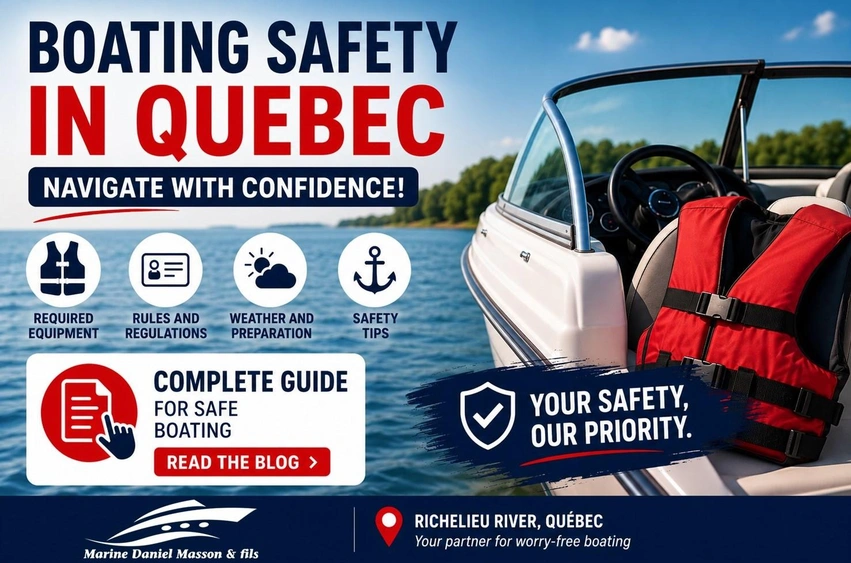
Boating Safety in Quebec: The Complete Guide to Navigating with Confidence
Everything You Need to Know to Safely Enjoy the St. Lawrence River, Lakes, and the Richelieu River
Boating is one of the most popular recreational activities in Quebec. Whether you own a pontoon boat, fishing boat, cruiser or yacht, boating safety should always be your top priority.
Every year, many boating incidents could be prevented through proper preparation, adequate safety equipment, and compliance with navigation regulations. A successful day on the water begins long before launching your boat.
At Marine Daniel Masson & Fils, we believe that an informed boater is a safer boater. That is why we have created this comprehensive guide to boating safety in Quebec to help you navigate with confidence on the Richelieu River, the St. Lawrence River, Lake Champlain, and waterways throughout the province.
Why Is Boating Safety So Important?
Boating offers an incredible sense of freedom, but the water remains an unpredictable environment.
Rapid weather changes, strong currents, shallow areas, floating debris, mechanical failures, or simple human error can quickly turn a great day on the water into an emergency situation.
Most boating accidents generally involve:
- Failure to wear a life jacket
- Poor trip preparation
- Excessive speed
- Alcohol consumption
- Lack of knowledge of navigation rules
- Inadequate safety equipment
The good news? Most of these situations can be prevented through a few simple precautions.
Legal Requirements for Boating in Quebec
In Canada, boating safety is regulated by Transport Canada. All boaters must comply with several essential requirements.
1. Hold a Pleasure Craft Operator Card (PCOC)
Anyone operating a powered boat must possess a valid Pleasure Craft Operator Card.
This certification confirms that the operator understands:
- Navigation rules
- Right-of-way regulations
- Emergency procedures
- Safety requirements
This card is mandatory throughout Quebec and Canada.
2. Carry the Required Safety Equipment On Board
Every vessel must carry the minimum safety equipment required for its size and type.
Among the most commonly required items:
Flotation Equipment
- One approved life jacket or Personal Flotation Device (PFD) for every person on board
- Properly sized for each passenger
- Easily accessible at all times
Emergency Equipment
- Buoyant heaving line
- Bailer or manual bilge pump
- Sound-signaling device (whistle or horn)
- Waterproof flashlight
- Functional navigation lights
- Anchor with appropriate rode and line
Additional Recommended Equipment
- Marine VHF radio
- Marine GPS
- First-aid kit
- Auxiliary battery
- Emergency tools
- Booster cables
- Approved fire extinguisher
3. Respect Your Boat’s Capacity Limits
Every boat has a maximum passenger and weight capacity.
Exceeding these limits can:
- Affect stability
- Increase the risk of capsizing
- Reduce performance
- Endanger passengers
Always follow the manufacturer's recommendations.
Life Jackets: Your Best Safety Companion
Statistics consistently show that most boating fatalities involve individuals who were not wearing a life jacket.
Even experienced swimmers may be unable to react effectively:
- After an impact
- In cold water
- Following an unexpected fall overboard
- In rough water conditions
The best life jacket is the one you are actually wearing.
For children, wearing a properly fitted PFD should be automatic from the moment they step aboard.
Pre-Departure Inspection: The Responsible Captain’s Routine
Before leaving the dock, take a few minutes to perform a complete inspection.
Boat Inspection
- Fuel level
- Engine oil level
- Battery charge
- Propeller condition
- Engine operation
- Navigation lights
- Electrical systems
Safety Inspection
- PFDs available
- Anchor on board
- Proper dock lines
- Accessible fire extinguisher
- First-aid kit
- Fully charged phone
This simple routine can prevent many problems while underway.
Check the Weather Before Every Trip
Quebec weather conditions can change rapidly.
Before every outing:
- Check the weather forecast
- Review wind advisories
- Monitor storm risks
- Evaluate expected visibility
On the Richelieu River, Lake Champlain, and the St. Lawrence River, conditions can change much faster than many boaters expect.
When in doubt, postpone your trip.
Alcohol and Boating: A Dangerous Combination
Operating a boat under the influence of alcohol carries risks similar to impaired driving on the road.
Alcohol affects:
- Judgment
- Reflexes
- Balance
- Reaction time
Penalties can be severe:
- Significant fines
- Suspension of privileges
- Criminal charges
The captain must always remain fully capable of operating the vessel safely.
The Captain’s Role: A Serious Responsibility
Being a captain involves much more than steering a boat.
The captain is responsible for:
- Passenger safety
- Compliance with navigation regulations
- Trip planning
- Vessel condition
- Managing emergency situations
A good captain anticipates risks before they become problems.
Safe Boating on the Richelieu River
The Richelieu River is one of Quebec’s most beautiful boating destinations.
Connecting the United States to the St. Lawrence River and ultimately flowing into the St. Lawrence at Sorel-Tracy, it passes through several iconic communities, including Saint-Jean-sur-Richelieu and Saint-Paul-de-l’Île-aux-Noix.
Boaters should remain vigilant due to:
- Heavy summer boating traffic
- Reduced-speed zones
- Variable currents
- Kayak and paddleboard traffic
- Navigation near docks and marinas
Experienced boaters also know that it is possible to travel the entire Richelieu River system by passing through its various locks and continuing toward the St. Lawrence River. It is truly a unique experience that creates unforgettable memories.
Complete Boating Safety Checklist
Before every departure, make sure you have:
☑ One approved PFD for every passenger
☑ A buoyant heaving line
☑ An appropriate anchor
☑ A bailer or bilge pump
☑ A whistle or horn
☑ A flashlight
☑ A first-aid kit
☑ A fully charged phone
☑ A functioning battery
☑ Sufficient fuel reserves
☑ Your boating documents
☑ Your Pleasure Craft Operator Card
☑ The latest weather forecast
☑ Shared your float plan with a trusted contact
Why Regular Boat Maintenance Matters
A well-maintained boat is a safer boat.
Preventive maintenance helps:
- Reduce the risk of breakdowns
- Extend the life of your vessel
- Improve performance
- Ensure compliance with safety regulations
An annual inspection remains one of the best ways to avoid unpleasant surprises during the boating season.
Marine Daniel Masson & Fils: Your Partner for Safe Boating
For more than 18 years, Marine Daniel Masson & Fils has been helping Quebec boaters enjoy their passion for life on the water.
Our team can help you:
- Choose the right boat for your needs
- Equip your vessel according to current regulations
- Perform recommended maintenance
- Prepare your boat for the season
- Navigate Quebec’s waterways with confidence
Our mission is simple: to help you enjoy every moment on the water safely and worry-free.
Conclusion
Boating safety is not a restriction—it is the foundation of an enjoyable and memorable experience on the water.
By following regulations, maintaining your equipment, monitoring weather conditions, and adopting safe boating practices, you significantly reduce risks while maximizing your enjoyment.
Whether you navigate the Richelieu River, Lake Champlain, the St. Lawrence River, or any other Quebec waterway, proper preparation will always make the difference.
Need Boating Safety Advice or Equipment?
The team at Marine Daniel Masson & Fils is here to help. Contact us today or visit our dealership to discover our boats, accessories, and services designed to help you navigate with confidence and peace of mind.